
Brand Identity
•
April 27, 2026
You paid a designer — maybe a good one — and you got back a logo, a color palette, and a couple of font files. It felt like a milestone.
Joe Abellard
Most Small Businesses Have a Logo. Very Few Have a Brand.
You paid a designer — maybe a good one — and you got back a logo, a color palette, and a couple of font files. It felt like a milestone. You updated your website, ordered business cards, and told yourself the branding was done.
Then six months later, your social media manager used a slightly different shade of blue. Your new employee put the logo on a presentation with a white drop shadow. The printer stretched it horizontally to fit the layout. And somewhere along the way, the clean, professional brand you invested in started looking like it was designed by four different people on four different days.
This is the most common — and most expensive — branding mistake small businesses make. And it almost always comes down to confusing two things that sound alike but function completely differently: brand identity and brand guidelines.
They’re Related, But They’re Not the Same Thing
The terms get used interchangeably so often that most business owners assume they mean the same thing. They don’t. Mixing them up is like confusing a car with its owner’s manual. One is the thing itself. The other is what tells you how to use it properly.
Brand identity is the what. It’s the collection of tangible creative assets that represent your business visually and verbally — your logo, color palette, typography choices, imagery style, iconography, patterns, and the tone of your written voice. Brand identity is the output of the creative process. It’s the stuff you can see, hear, and feel.
Brand guidelines are the how. They’re the rulebook that explains how to use those assets correctly, consistently, and in every context your business operates in. Logo clear space rules. Approved color variations. Typography hierarchy. Photography direction. What you should never, ever do with the logo. Brand guidelines are the instruction manual for your brand identity.
The core distinction: Brand identity is created once. Brand guidelines ensure it’s used correctly forever.
Without one, the other falls apart. A beautiful brand identity without guidelines is just a collection of files sitting in a Dropbox folder, waiting to be misused. And guidelines without a strong identity underneath them are just rules about nothing.
Why Small Businesses Get This Wrong (It’s Not Their Fault)
Here’s the honest truth: the design industry hasn’t always been great at explaining this. Many designers deliver a logo package and call it “branding.” Some include a basic style guide — a PDF with the hex codes and font names — and call it “brand guidelines.” Neither of those things is wrong, exactly, but they create a gap in understanding that costs clients real money down the road.
When a small business owner hears “brand guidelines,” they often picture a 100-page PDF that only enterprise companies need. Something for Nike or Apple, not a 12-person accounting firm in St. Louis.
That assumption is exactly backwards.
Large companies can survive brand inconsistency because they have enough market presence to absorb it. Small businesses don’t have that cushion. Every touchpoint matters more when you have fewer of them. Every inconsistency hits harder when your audience is smaller and still forming their impression of you.
The businesses that need brand guidelines most are the ones least likely to think they do.
What “Death by a Thousand Inconsistencies” Actually Looks Like
Consider a scenario that plays out constantly. A small business owner builds a solid brand identity — thoughtful logo, intentional colors, clean typography. Then growth happens. They hire a part-time social media manager. They bring on a contractor to build out a trade show booth. They ask their office manager to put together a client proposal. They hire a new sales rep who creates their own email signature.
None of these people are trying to damage the brand. They’re just doing their jobs with the information they have, which is usually just the logo file and a vague sense of “we’re a blue and gray company.”
Within a year, the brand that looked sharp and intentional on day one now looks like a patchwork quilt. The blue is three different blues depending on who made the asset. The logo appears in a circle on Instagram, stretched on the proposal, and floating on a dark background on the trade show banner. The tone of the social captions sounds nothing like the tone of the website.
This isn’t a hypothetical. This is Tuesday for most growing small businesses.

The SEO Angle Nobody Talks About
Here’s something that surprises most business owners: brand consistency isn’t just a visual problem. It directly affects how Google and AI search engines understand and rank your business.
Search engines are increasingly sophisticated at recognizing brand entities — the idea that your business is a real, coherent, trustworthy presence across the web. When your business name, logo, color usage, and messaging are consistent across your website, social profiles, directories, and content, you send strong brand entity signals that reinforce your authority in search.
When they’re inconsistent? You create confusion — not just for customers, but for algorithms trying to determine whether your Instagram page, your Google Business profile, and your website are actually the same company.
Brand consistency across platforms is both a customer experience strategy and an SEO strategy. They’re the same thing.
At Consort Creative, our Grow services are built on this principle — that a consistent brand is the foundation that makes every marketing and SEO effort work harder. You can’t build domain authority on a crumbling brand foundation.
What Good Brand Guidelines Actually Include
This is where it gets practical. A real set of brand guidelines — not a two-page PDF with font names — covers the full operating system of your brand. Here’s what that looks like in practice.
Logo usage rules go far beyond just providing the file. They specify minimum size requirements so the logo never gets used so small it becomes illegible. They define clear space — the breathing room required around the logo that no other element can invade. They provide approved color variations (full color, one-color, reversed on dark backgrounds) so there’s always a correct version for every context. And critically, they show explicit examples of what not to do: no stretching, no drop shadows, no unapproved color swaps, no placing the logo on a busy background without a container.
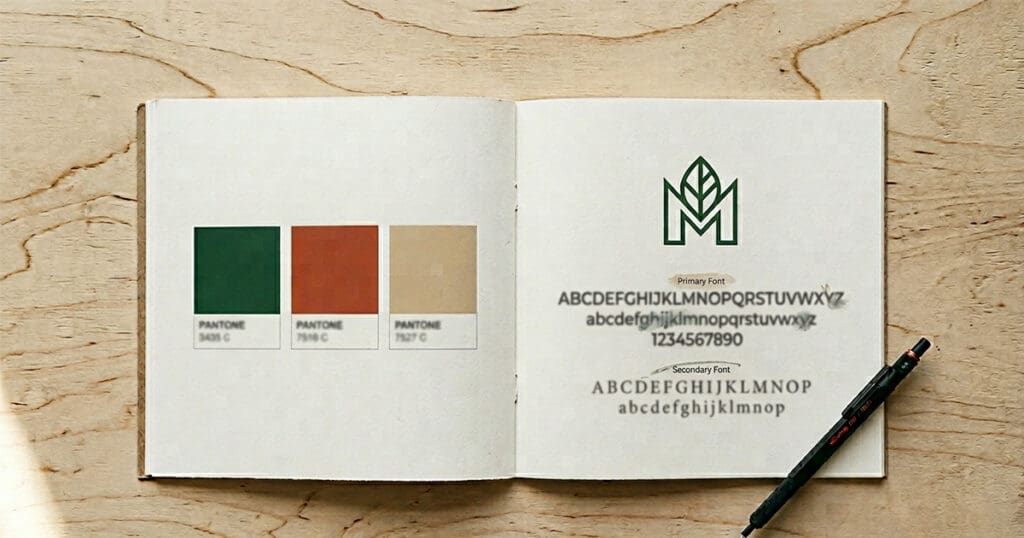
Color specifications go beyond “we’re a navy blue company.” Good guidelines provide the exact hex code for digital use, the RGB values for screen applications, the CMYK breakdown for print, and the Pantone match for when color accuracy is non-negotiable (think branded merchandise or large-format printing). They also define primary, secondary, and accent colors — and the rules for how they interact.
Typography systems define not just which fonts the brand uses, but how they work together. Which typeface is for headlines? Which is for body copy? Is there an accent font for pull quotes or callouts? What size hierarchy creates visual rhythm in a document? This is the difference between a brand that looks designed and one that just looks like someone picked fonts they liked.
Imagery direction tells anyone creating content what kinds of photos, illustrations, or icons feel right for the brand — and which ones don’t. A law firm and a craft brewery might both use photography, but the subject matter, lighting style, and emotional tone of those photos should be completely different. Guidelines make that explicit.
Voice and tone guidelines are the most underrated section of any brand guide. They explain not just what the brand says, but how it says things — formal or casual, technical or plain-spoken, warm or authoritative. They often include example rewrites: here’s how we’d say this wrong, here’s how we’d say it right.
Beyond those core sections, strong guidelines also include social media templates, business card and letterhead specifications, and email signature standards — the everyday touchpoints where brand consistency either holds or falls apart.
Brand Identity vs. Brand Guidelines: A Clear Comparison
| Brand Identity | Brand Guidelines | ||
|---|---|---|---|
| What it is | The creative assets themselves | The rulebook for using those assets | |
| Includes | Logo, colors, fonts, imagery, voice | Usage rules, specs, do’s & don’ts, examples | |
| Created | During the design phase | Alongside or after the design phase | |
| Purpose | Define how the brand looks and feels | Ensure consistent application everywhere | |
| Who uses it | Designers building the brand | Everyone who touches the brand | |
| Without it | No visual identity exists | Identity gets misused and diluted | |
| Analogy | The car | The owner’s manual |
When You Actually Need Brand Guidelines (Hint: Sooner Than You Think)
The honest answer is that you need brand guidelines the moment someone other than the original designer touches your brand. But there are specific inflection points where the absence of guidelines becomes genuinely costly.
When you start hiring contractors or freelancers, you’re handing your brand to someone who has never worked with it before. Without guidelines, you’re paying for their guesswork and your revisions. When you onboard new employees — especially anyone in marketing, sales, or customer-facing roles — guidelines become an onboarding tool, not just a design document.
When you expand to new marketing channels, each platform has its own format requirements and audience expectations. Guidelines help you adapt without losing coherence. When you’re preparing for growth — whether that means seeking investment, opening a second location, or launching a new product line — investors and partners look for operational maturity. A brand that looks different everywhere signals a business that isn’t ready.
The cost of creating brand guidelines once is almost always less than the cumulative cost of fixing inconsistency over time — in designer revision fees, reprinted materials, and the slower, harder-to-measure erosion of customer trust.
How Consort Creative Thinks About This
At Consort, we treat brand identity and brand guidelines as two distinct but inseparable deliverables. The identity is built during the Design phase — the creative work of developing a visual and verbal system that’s right for your business, your market, and your growth goals. That process starts upstream, in the Discover phase , where brand strategy defines the positioning and personality that the identity will express.
But the guidelines are what make that investment durable. They’re the document — or in many cases, the living digital guide — that travels with your brand into every context it will ever appear in. They’re what you hand to a new hire on day one. They’re what you send to the printer, the web developer, the trade show vendor, and the social media agency.
Without guidelines, even the best brand identity has a shelf life. With them, the brand you build today can grow with you for years without losing the coherence that makes it work.
The Bottom Line
A logo is not a brand. A color palette is not a brand. Even a beautifully designed visual identity system is not, by itself, a brand — not until it has the infrastructure to be used consistently across every touchpoint, by every person, in every context.
Brand identity tells the world who you are. Brand guidelines make sure that message stays clear no matter who’s delivering it.
Small businesses that understand this distinction don’t just look more professional — they build faster, waste less money on rework, and create the kind of consistent customer experience that compounds into real brand equity over time.
The businesses that don’t? They keep wondering why their brand never quite looks as good in practice as it did in the original design presentation.
Ready to Build a Brand That Works Everywhere?
If you’re not sure whether you have brand guidelines — or whether the ones you have are actually doing the job — let’s talk . Consort Creative works with small and mid-sized businesses nationwide to build brand identities and the guidelines systems that protect them.
Frequently Asked Questions
What’s the difference between brand guidelines and a style guide?
They’re often used interchangeably, and in most contexts, they mean the same thing. Some agencies use “style guide” to refer to a narrower document focused primarily on visual standards, while “brand guidelines” tends to imply a more complete system that includes voice, tone, and messaging alongside visual rules. At Consort, we build comprehensive brand guidelines that cover both — because visual consistency without verbal consistency only solves half the problem.
Do small businesses really need brand guidelines, or is that just for big companies?
Small businesses actually need them more, not less. Large brands can absorb inconsistency because they have years of market presence behind them. Small businesses are still forming their reputation with every customer interaction. A consistent brand builds trust faster, and brand guidelines are the tool that makes consistency possible when you’re working with contractors, part-time staff, or multiple marketing channels simultaneously.
How long does it take to create brand guidelines?
It depends on the scope of the identity system and the depth of the guidelines. A focused small business brand with a clear visual system might have guidelines completed within a few weeks as part of a broader branding engagement. More complex systems — multiple logo variations, extensive photography direction, detailed voice guidelines — take longer. At Consort, guidelines are built as part of our Design phase, so they’re developed in parallel with the identity itself rather than bolted on afterward.
What format should brand guidelines be in?
PDF brand books are the traditional format, and they’re still useful for sharing with printers and external vendors. But increasingly, the most functional format is a digital brand portal — a web-based document that’s always current, easily searchable, and accessible to anyone on your team without having to track down the latest file version. For growing businesses, we generally recommend a digital-first approach with a print-ready PDF as a secondary deliverable.
Can I create brand guidelines myself if I already have a brand identity?
Yes, and it’s worth doing even imperfectly if you don’t have them at all. Document your hex codes, your approved logo files, your fonts, and the basic rules for how they’re used. That’s a starting point. The limitation of DIY guidelines is that they often miss the nuance that makes them genuinely useful — the “don’t do this” examples, the typography hierarchy, the photography direction, the voice and tone guidance. A professionally built guidelines document pays for itself the first time it prevents a costly reprint or a brand-damaging misuse.
How does brand consistency affect SEO?
Search engines increasingly evaluate businesses as entities, not just collections of keywords. When your brand name, visual identity, and messaging are consistent across your website, social profiles, Google Business Profile, and third-party mentions, you reinforce your brand’s authority and trustworthiness in search algorithms. Inconsistency — different logo treatments, varying business name formats, mismatched messaging — creates ambiguity that can dilute your search presence. Brand guidelines ensure the consistency that supports both customer recognition and search engine confidence. Our Grow services are built on exactly this principle.


- READY TO ACT ON THIS
Your Brand Should Be Working While You're Not.
If this article resonated, the next step is a free 30-minute conversation. No pitch, no pressure — just clarity about where your brand stands and what's worth fixing first.
Book a Free Discovery Call