
Brand Identity
•
February 13, 2026
In the digital world, a pretty website isn’t enough. You might have stunning graphics and smooth animations, but if your site doesn’t communicate who you are and why you matter,
Joe Abellard

In the digital world, a pretty website isn’t enough. You might have stunning graphics and smooth animations, but if your site doesn’t communicate who you are and why you matter, it won’t convert visitors into customers. Brand strategy for small business websites is essential.
This is where brand strategy comes in. It is the blueprint that guides every pixel, button, and headline on your site. Here is how a solid brand strategy acts as the foundation for every successful website.
Why Strategy Comes Before Design
Many businesses make the mistake of diving straight into design. They pick colors and fonts they “like” without considering their audience.
A brand-first approach flips this script. It asks critical questions before a single line of code is written:
- Who is your ideal customer?
- What problem are you solving for them?
- What is your unique voice?
When you answer these questions first, your website becomes a tool for business growth rather than just a digital brochure. Google’s AI algorithms also favor websites that have a clear purpose and target audience, helping you rank higher in search results.
Consistency Builds Trust (and Rankings)

Have you ever visited a website that felt disconnected from the company’s social media or packaging? That confusion kills trust.
Brand strategy ensures consistency. When your logo, color palette, typography, and tone of voice are uniform across all pages, visitors feel more comfortable. They instinctively trust that you are professional and reliable.
From an SEO perspective, consistency keeps users on your page longer. Lower bounce rates signal to search engines that your site is valuable, which boosts your rankings.
User Experience (UX) is Brand Experience
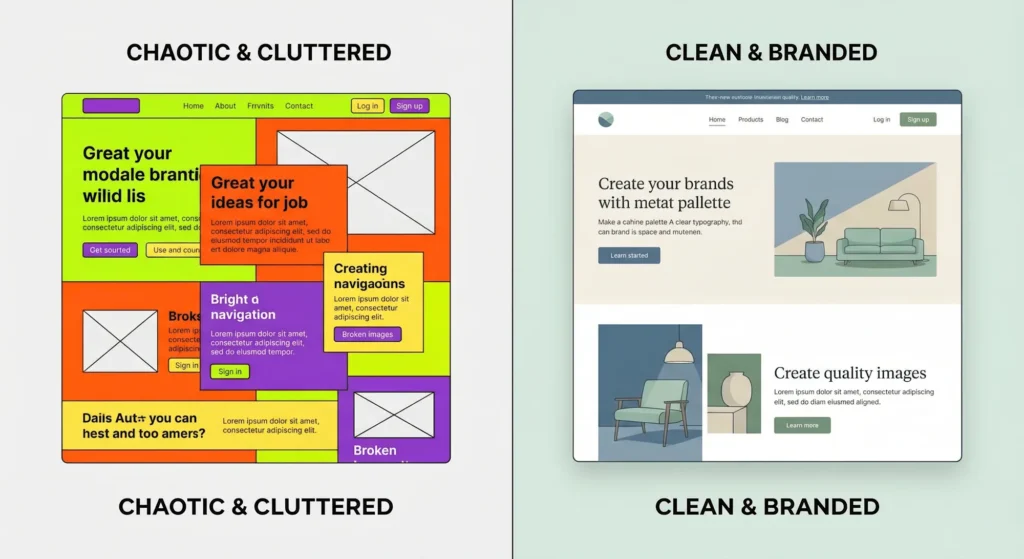
Your brand isn’t just what you say; it’s how you make people feel. On a website, this feeling is delivered through User Experience (UX).
- A luxury brand might use a minimalist layout with slow, elegant transitions.
- A high-energy tech startup might use bold colors and punchy, fast-loading interactions.
If your strategy defines your brand as “helpful and accessible,” but your navigation is confusing, you are breaking your brand promise. Aligning your UX with your strategy ensures that every click reinforces your identity.
What Brand Strategy Looks Like in Practice
Consider two small businesses offering identical services — say, two residential landscaping companies in the same city, with similar pricing and quality. One has a logo designed years ago, a website that doesn’t reflect a clear positioning, and social media that looks disconnected from the site. The other has a consistent visual system, a clear audience (“premium residential clients who want a hands-off experience”), and content that speaks directly to that customer’s concerns.
The second business doesn’t need to outspend its competitor on ads. Its brand is doing the work: attracting the right clients, filtering out the wrong ones, and converting visits into calls at a higher rate. That’s what brand strategy actually delivers — not a logo, but a business tool.
At Consort Creative, every website project begins with brand strategy. We ask: who is this site for, what do they need to believe before they convert, and what experience should every page create? The design answers those questions. The content reinforces them. The result is a website that works with your brand rather than independently of it.
Content That Connects
Finally, brand strategy dictates your content. It tells you whether your headlines should be witty and playful or serious and authoritative.
Google’s latest updates prioritize “helpful content.” By sticking to a clear brand strategy, you naturally create content that is relevant to your specific niche. This authority is exactly what search engines are looking for when deciding who to place on the first page.
Conclusion
Your website is often the first interaction a potential customer has with your business. Don’t leave it to chance. By letting brand strategy shape your design, UX, and content, you build a website that doesn’t just look good—it works.
What is brand strategy for a website?
Brand strategy for a website is the process of defining who your site is for, what it needs to communicate, and what action it should drive — before any design work begins. It covers audience definition, messaging hierarchy, tone of voice, and how each page connects to the others to move a visitor toward a decision. Without strategy, web design is decoration. With it, every visual and content choice serves a measurable business purpose.
How does brand strategy affect website conversions?
Brand strategy directly affects conversions because it aligns your site’s content, structure, and visual language with the psychology of your ideal customer. When visitors immediately understand who you serve, what problem you solve, and why you’re the credible choice, the conversion path shortens dramatically. Most low-converting websites have a design problem on the surface and a strategy problem underneath.
Does a small business need brand strategy before building a website?
Yes — and the order matters. Brand strategy answers the questions that determine every design decision: what colors communicate trust in your specific market, what tone converts your specific audience, what structure guides your specific buyer journey. Building a website before answering these questions means making every decision twice — once when you build it and again when you realize it isn’t working.
How long does brand strategy take before a website project can begin?
A focused brand strategy engagement for a small business typically takes 2–3 weeks. This includes a discovery session (usually 2–3 hours), research and analysis, and delivery of a strategy document that guides the design and content work. This front-loaded investment consistently reduces design revision cycles and produces websites that perform from launch rather than after a round of post-launch fixes.
Can I update my existing website to reflect better brand strategy without a full redesign?
In many cases, yes. Strategic content updates — clarifying your homepage headline, restructuring your service pages around customer outcomes, sharpening your calls to action — can meaningfully improve performance without touching the design. A brand and website audit is the fastest way to identify which specific elements are costing you conversions and whether a targeted update or a full redesign is the more efficient path.
Reach out to us for a Free Brand Audit



- READY TO ACT ON THIS
Your Brand Should Be Working While You're Not.
If this article resonated, the next step is a free 30-minute conversation. No pitch, no pressure — just clarity about where your brand stands and what's worth fixing first.
Book a Free Discovery Call